
- Communications 14,117
- Earth observation 1,512
- Space observation 72
- Other 1,774
Positions modelled from public orbital elements (3 Oct 2026), not live tracking. Point at any light to identify it · click anywhere on Earth to see who can image it next.
Find the spacecraft.
Brief the mission.
Get the results.
Anaxes is one place for companies and government teams to buy what satellites can do, from the first search to delivered results.
17,469 spacecraft in the catalog
FIG. 02 — The catalog
Catalogued spacecraft by launch year
91% of the 17,469 spacecraft in the catalog launched in 2020 or later. The 16,711 with published orbits are on the globe, placed from their public orbital elements (modelled, not live tracking).
FIG. 03 — Earth observation
Earth observation, inclination against altitude
1,512 Earth-observation spacecraft. Most fly sun-synchronous orbits near 97°, crossing each latitude at the same local time, like Landsat 9, painting its 185 km swath on the globe. Ask for an area, a resolution, cloud cover and revisit.
FIG. 04 — Communications
Communications spacecraft by altitude
14,117 in the catalog, from the low-orbit shells near 500 km to the geostationary belt at 35,786 km. Request throughput, latency, band, terminals and availability for a region or a set of sites.
FIG. 05 — Space observation
Space observation, in orbit now
72 spacecraft that observe other objects in orbit, each locked on the globe in turn. Inspection, fly-bys, debris characterisation and astronomy.
FIG. 06 — Docker Doctor · In-orbit servicing
Any spacecraft can be the client
The International Space Station, modelled from its public elements. Request inspection, orbital readjustment, repair or refit for any named spacecraft in the catalog.
FIG. 07 — The problem
Buying from space still runs on email. There are thousands of working spacecraft and a growing list of operators, yet a team that needs imagery of a port still has to work out who can do it, then run a separate sales process with every provider.
- P-01Capability is hard to see. Specifications are scattered across catalogs, operator sites and filings, in different units and levels of trust.
- P-02Every provider sells differently. Separate contacts, contracts and quote formats make options slow to compare.
- P-03Results arrive without context. Files land in inboxes, cut off from their licence, their source and what was actually observed.
A few of the 1,512 Earth-observation spacecraft in the catalog · NORAD ID
- SENTINEL-3C 100690
- LANDSAT 9 49260
- ICEYE-X79 69870
- CAPELLA-20 68485
- PLEIADES NEO 4 49070
- NISAR 65053
- WORLDVIEW-3 40115
- KOMPSAT-7 66820
- ALOS-4 60182
- UMBRA-12 67371
- CARTOSAT-3 44804
- EARTHCARE 59908
- SWOT 54754
- TERRASAR-X 31698
- RADARSAT-2 32382
- CSG-3 67304
- GOES 19 60133
- SAOCOM 1B 46265
FIG. 08 — The platform
One workflow, three products.
-
01 / Discover
StarSearch
Describe the mission in plain words. Every candidate appears on a 3D globe with the evidence behind the match, and gaps in the record are flagged instead of filled.
-
02 / Decide and track
Mission Control
Our team reviews each brief with operators who can fulfil it and publishes quotes. Accept one, then follow the schedule and every event on one timeline.
-
03 / Receive and analyse
SatSuite
Results land in a private library, virus-scanned, hashed and licensed. Catalog facts, our findings and provider statements stay side by side, never blended.
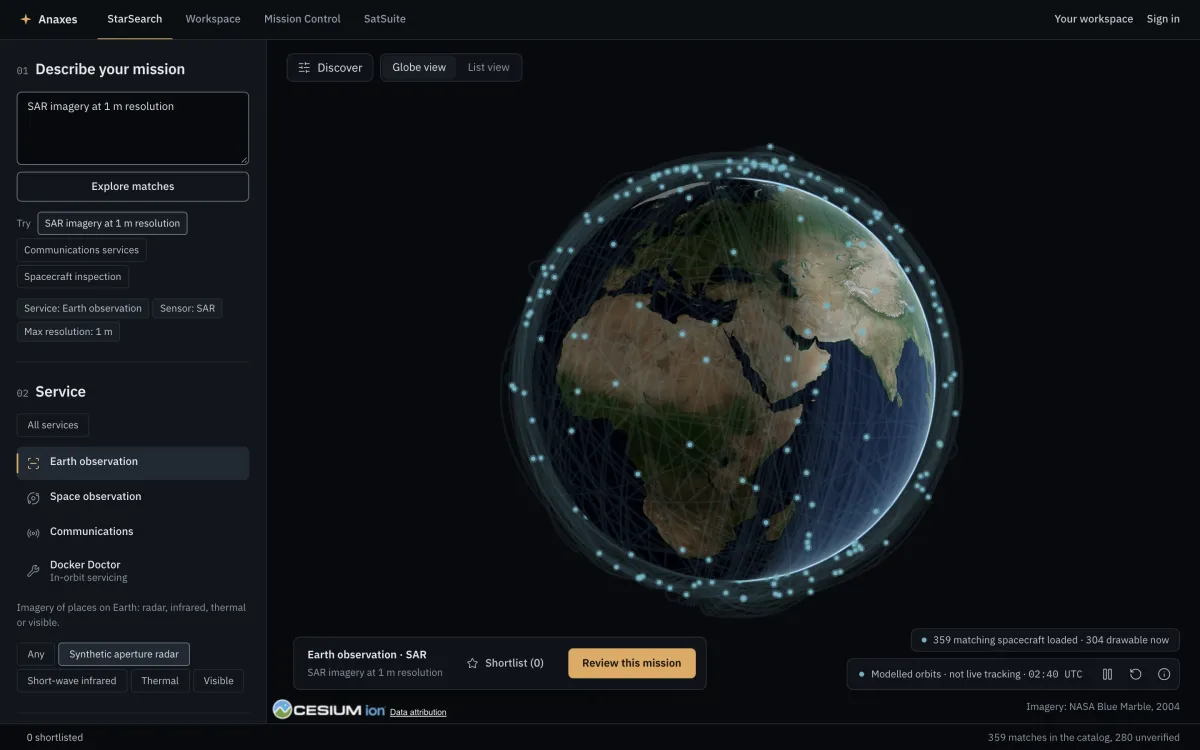
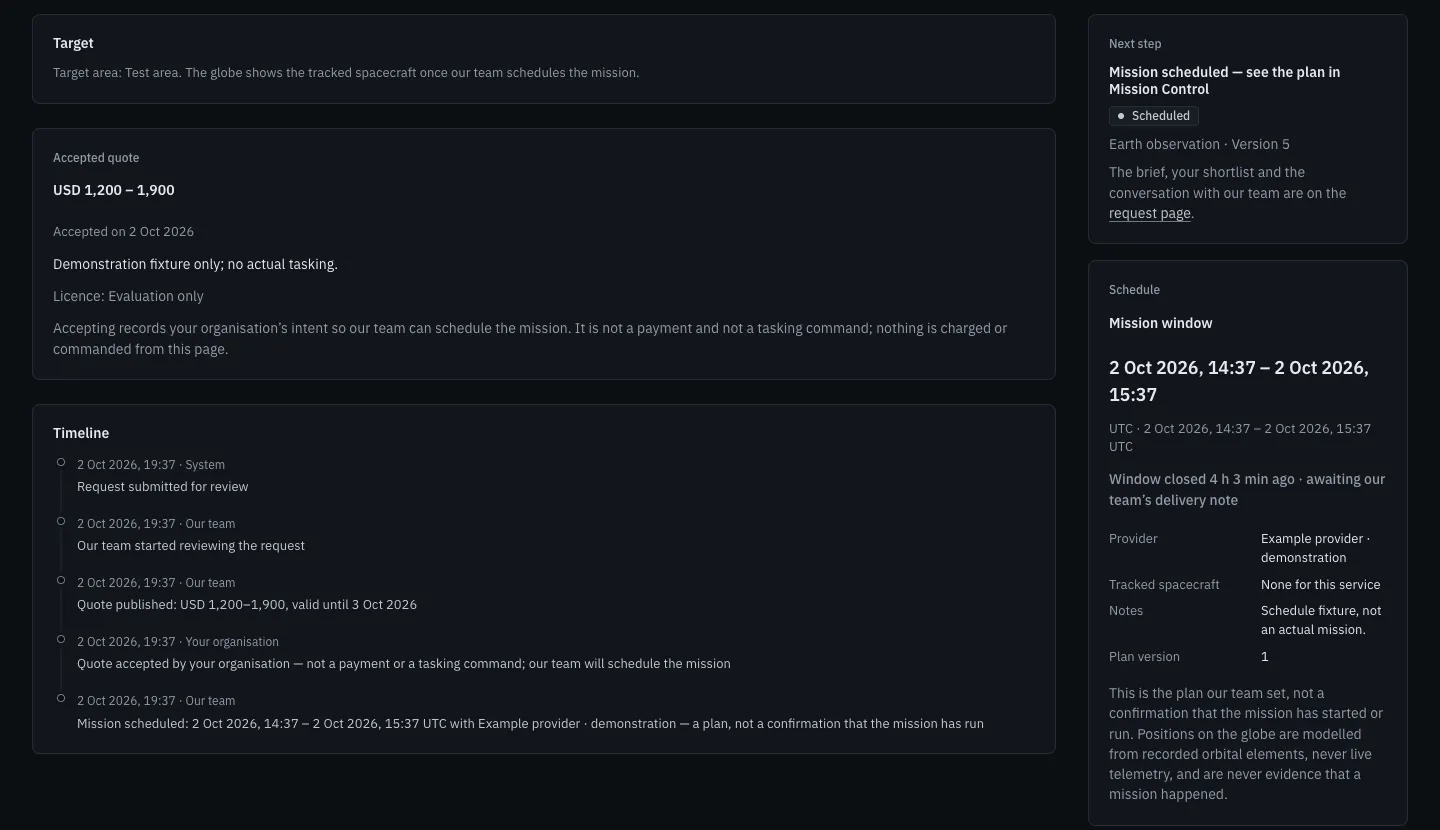
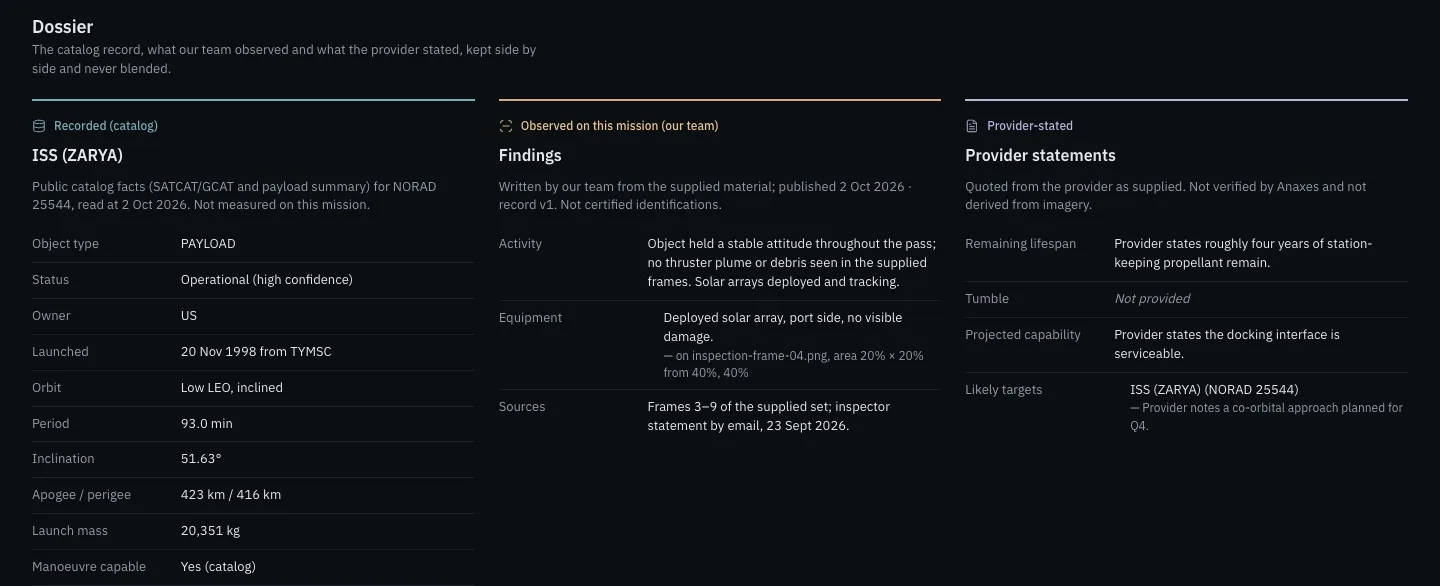
FIG. 09 — How it works
From question to results in five steps.
01
Describe
Say what you need in plain words, or pick a service family and set requirements.
02
Shortlist
Compare matching spacecraft on the globe or as a list, with the evidence behind each match.
03
Brief
Submit one brief with the area or target, time window and requirements. Missing details can follow later.
04
Quote
Our team reviews the brief with capable operators and publishes quotes. Accepting never charges a card or commands a spacecraft.
05
Receive
Follow the mission in Mission Control and inspect the delivered results in SatSuite.
FIG. 10 — Who it's for
For teams that need answers from orbit, not a space programme.
FIG. 11 — How we handle data
Honest about what the data can and cannot tell you.
- D-01
Modelled, and labelled that way
Positions come from public orbital elements and are marked as modelled. Stale elements are flagged rather than shown as current.
- D-02
Evidence, not guesses
A match is shown with the catalog evidence behind it. When a requirement is not recorded for a spacecraft, we say so.
- D-03
Licences enforced
Originals are released only when the licence allows it. Otherwise you get a preview with metadata removed, and the original's hash for audit.
FIG. 12 — Team
Built by people who hit the wall themselves.
Donghyun needed current imagery of the Weddell Sea for research on Antarctic upwelling and found there was no way to get it. Beomjun, building a CubeSat at Berkeley, watched his team rebuild capabilities that were already in orbit because they had no access to the hardware up there. Anaxes is the access they were missing.
FIG. 13 — Orbit regimes, to scale
Space capability, on request.
StarSearch is live. Explore 17,000+ spacecraft, shortlist what fits and start a brief.
Open StarSearch